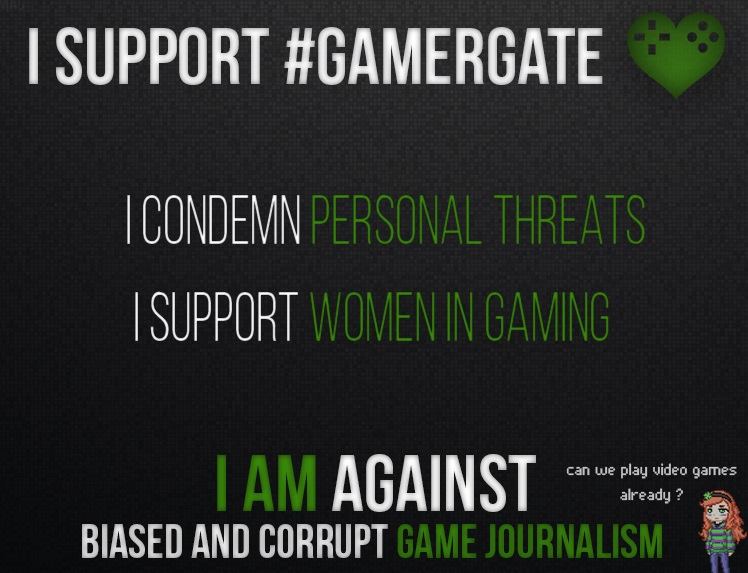
Everyone has a different story of how they got involved for/against gamergate and what it is about. Here is mine.
Although I did not realize it at the time, my involvement in #gamergate began when I started seeing articles alleging that a games developer had cheated in a relationship with a reporter for a games-focused website, and that games sites everywhere, not just the one involved were censoring (moderating) discussion on it.
At the time, I did not pay too much attention to news that the developer of a game I don't own slept with a reporter whose articles I don't read. The suppression of discussion did bother me a bit -- I prefer a free-wheeling Internet where anything and everything can be discussed/debated/etc. It also seemed very strange that sites that allowed fairly major blowups over, for example, conference attendees who made sexist jokes and a game jam gone horribly wrong would not allow discussion of other indiscretions. But I assumed that the Streisand effect (in which a suppressed discussion on the Internet simply becomes more widely publicized) would work as normal. Either way, I didn't particularly care. But then the infamous "Gamers are Dead" articles were released, and I found myself on one side of a war.
We are all aware of the stereotypes associated with various hobbies and interests -- but only the most ignorant actually believe them. During my sophomore year, our school quarterback was not just an engineering major, but double-majored in the liberal arts honors program. This knowledge did not prevent the rest of us from exchanging dumb jock jokes though. Similarly, we know that the stereotypical "gamer" is a 30-year old male virgin living in his parent's basement. Until reading one of those articles, I didn't think anyone actually believed it.
Some people pay hundreds of dollars for superbowl tickets, plus more for transportation. Some people pay thousands of dollars to golf on a private course instead of a public one. Some people drive 50 miles each way every weekend because the movie theater the next town over is "better" than the one in town. In the case of gamers, it is paying a lot extra to get a nicer computer, better mouse and keyboard, and yes, "Queuing passionately for hours, at events around the world, to see the things that [they] want ... to see."
And yet a series of articles--from people claiming to be games journalists-- have presented the negative stereotypes as facts, urged gamers to drop their identity, and urged businesses to no longer market products to them. Imagine for a moment if Golf Digest wrote an article proclaiming that golfers were just a bunch of rich white guys who were too busy abusing their staff to notice that golfing culture had changed because look -- over 10 years ago a black man named Tiger Woods won the Masters tournament --- and that anyone who wasn't racist needed to stop claiming to be a golfer. Imagine if an anchor of E! reported on a Hollywood premier by saying "There is a whole crowd of losers getting wet in the rain just hoping to get a glimpse of a bunch of overrated actors no one cares about because we just watch it on Neflix now." Take the outrage either one of those events would cause, and multiply by eleven because multiple gaming sites simultaneously released inflammatory anti-gamer editorials.
Added to the outrage: Most gaming sites banned any discussion on gamergate. A follow-up article that possibly was intended as an olive branch can best be paraphrased as "If you aren't a basement-dwelling socially misfit man-child, you aren't the people the author was talking about". Since the normal places I go for discussion were censoring/moderating discussion, I turned to Twitter (read-only since I don't have nor want an account). I learned that apparently someone had made harassing phone calls to the original developer, and that therefore gamergate, in addition to being socially inept basement-dwelling adult infants, was also a mysonigistic conspiracy angry about an influx of female programmers [News flash: The first programmer of any kind was a woman who wrote code for Babbage's difference engine]. Any attempt to correct this impression was met by "I'm not talking to you until you apologize for your harassment."
For the record: I have not exchanged personal messages of any kind with either the developer involved nor the reporter involved. I have no knowledge of who did. I do not support harassment by either side. And I have absolutely nothing to apologize for. On the other hand, I have been stereotyped, censored, silenced, and marginalized. I refuse to sacrifice my identity to the altar of political correctness based on ignorant stereotypes and some sort of theory of collective guilt.
Other things I learned on Twitter: I already knew that half of gamers were women - I learned that over a hundred of them specifically support GamerGate. I learned that the journalists had a members-only mailing list which specifically coordinated their response - an event that would be known as collusion if it occurred in any other industry. Oh, and I learned that #gamergate has "an image problem" in that people seem to think it is about mysogyny and harassment. My diagnosis: our opponents are games writers who have established sites with significant traffic; who were writing anti-gamer articles from the beginning; and who ban/moderate any counter discussion. It is no wonder onlookers have gotten a one-sided view of the situation -- and I am unconvinced that changing the name of either my hobby nor my issues will change that.
Anyway, that was how/why I decided to support GamerGate. As for what I have concluded? I am fortunate to live in a nation where it is legal to make games and legal to play them. And thus, there will always be some people for whom games are their most important hobby. It is annoying to be constantly accused of crimes I have not done, to be accused of political views I do not have, and to be stereotyped, insulted, and moderated out of any discussion of any of the above. What I can do about it: Continue to buy games, continue to play games, continue to talk about games. What else I can do about it: Refuse to patronize websites that treat gamers with contempt, and inform companies whose products I use which websites are treating their customers with contempt. All of these can be done without changing anyone's mind, improving the image "the public" has of me, or really taking any public action at all. But what I'd really like is a games-oriented web site with factual news, sincere reviews, open discussion---- and ideally run by someone who doesn't hate my guts.